Another passive time loss guy: George Orr from LeGuin’s The Lathe Of Heaven

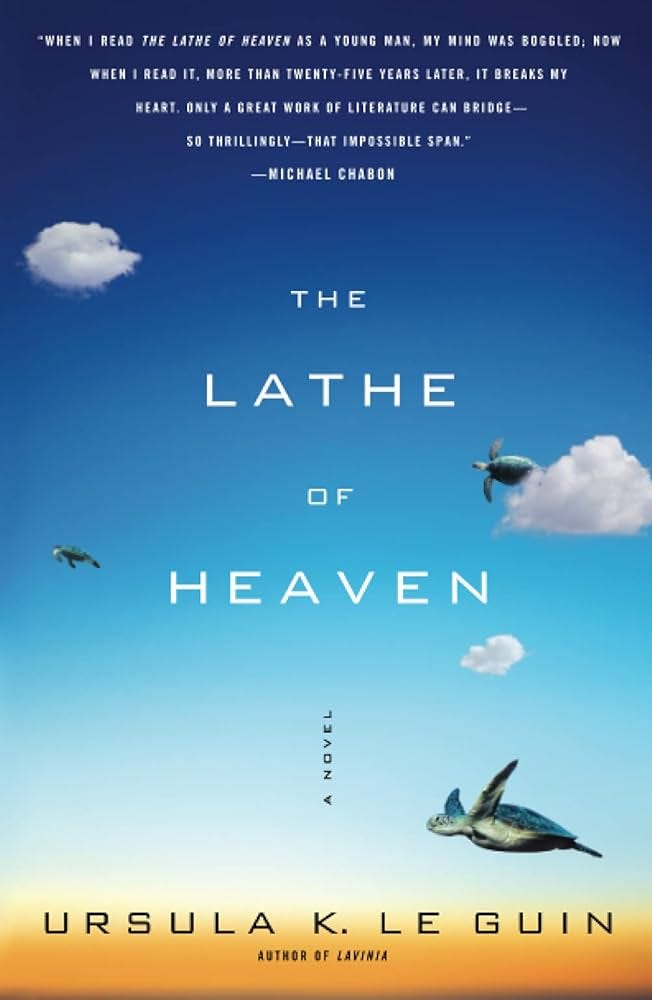
The Lathe of Heaven is my favorite LeGuin book. I reread it on the train on the way to visit the Center for Cartoon Studies in Vermont this weekend–motivated in part by the cycle of catastrophic expectation circling through my daydreams about what the power-hungry patriarchal white men in charge of the U.S would do to other people around the world.
Something terrifying for many Americans right now is that the myth of America as a global benevolent hegemon has disintegrated further than many Americans were led to expect by their WTO-subsidized youth. It has been a long time since America’s vast military apparatus has appeared as a guarantor of peace. This International Women’s Day, Gaza is still starving under bombs; Israel is killing Palestinians in the West Bank and Lebanese civilians north of their border; Sudan has seen no relief; the Donbass region is still caught in the crosshairs of two militaries; hundreds of thousands of people who had been fed by USAID or supplied HIV medication by our proxy healthcare organizations are now sick or dead. At home, we detain mothers with babies, kill Rohingya refugees and white American nurses, and are targeted by police if we suggest we don’t want nature preserves to become militarized police training camps. Where is the figure of the benevolent father? Why can’t we just have Obama back, who had such a soothing voice when announcing strikes on Libya?
This war with Iran has a few possible justifications from the perspective of “benevolent hegemony”. An Iranian-American woman who was in my History honors program at University of Washington in 2015 messaged me on Instagram after I reposted information about the bombing of the Shajareh Tayyebeh school in Minab on Feb 28. She wanted me to keep in mind the thousands of people that have been reported murdered by the government and affiliated militias in the January 2026 protests against the Iranian regime. A Guardian article says the dead from January may number upwards of 20,000, though that’s difficult to verify; the government has acknowledged a few thousand dead and local doctors allege mass graves and people disappeared form hospitals. Some Iranian-Americans, with more or less monarchist leanings, have advocated for U.S military intervention, with the logic that anything the U.S can do to their country cannot be worse than what the Islamic Republic is doing already. It is clear to me that the Islamic Republic’s brutality towards young protesters is real, whatever the actual casualty numbers. It’s equally clear that Israeli/U.S strikes are not being carried out with the goal of protecting Iranian civilians; they would not be bombing oil infrastructure, causing poison rain, if that was their aim. As the Columbia Free Press says, nobody has ever bombed their way to democracy.
Liberal pundits express constant bafflement at the way our current head of state and his military goons don’t even bother to justify bombing other people by saying it’s for their own good. It’s hard to get used to the change. The New York Times is a dog in a hot car, panting: “why are we in this war, Mr. President?” Meanwhile, NPR has been running specials about the ancient ties between Persian and Jewish people (Israel and New Iran might get along!) and the apparently legitimate case the Pahlavists have for wishing for a new nationalism–in the apparent hope that the U.S turns to a monarchist regime change operation in place of the campaign of school bombings, destruction of civilian infrastructure and sectarian fracture which appears to be the actual strategy. As Pete Hegseth says, “the only people who should be worried are the Iranians who think they’ll live”.
The Lathe of Heaven (1971) is about a white man who allows another white man to dominate him–and through him, the world. It is about white men’s dreams of possible good futures, and their attempt to shape these futures alone. It is about passive collaboration with horrible murderers. It is about the breakdown of belief in powerful benevolence, in unilateral control, in a guiding hand one way or another. It’s also an effective critique of science-fiction tropes common among male sci fi writers of the 50s, 60s and 70s, and of the dreams they found possible. It’s a more compact book than many others of LeGuin’s, and–my opinion– the prose is tighter and more effective. Because the reader moves through a kaleidoscope of slightly different realities throughout, each sentence is load-bearing– it tells us about shifts between this waking moment and the last one we remember. I enjoyed the catharsis of reading this book partly because it felt like living in our nightmare news cycle. Each time you open your eyes, the world is different, and even if someone claims it’s for the better, it rarely is. You choose to go along with your daily life in the new world, where people are suffering in new and interesting ways, because you are at the eye of the storm– these new and interesting horrors never touch you, personally. You feel that you must break away from or destroy the tyrant who holds you in thrall, but you cannot.
Like Mikey in My Own Private Idaho, George Orr is a Pacific-Northwest-based passive victim of his own sleep– but unlike Mikey, his dreams reshape reality, rather than just reflect it. George Orr is a dreamer whose dreams are “effective”; case in point, when his aunt sexually abused him in adolescence, he had a dream where she died in a car crash that, upon waking, became the truth–six weeks past. He cannot control his dreams; he knows they spring from his subconscious, rather than conscious, desires, and he fears what they can do, even though one of his first effective dreams rewrote history away from a nuclear holocaust which had, in his original timeline, killed everyone he knew. So he’s been medicating himself into exhaustion. When his current reality’s authorities learn of his drug use, they prescribe him a “voluntary therapy” as an alternative to incarceration. Orr goes; there he meets William Haber, a masculine red-bearded “bear” of a man whose specialty is dreams, and who basically immediately attempts to control George’s dreams with a device he calls the “augmentor”. Haber then uses George’s dreams, which he controls, as an instrument to implement a range of “better” futures, all of which come with promotions and improvement of material circumstances for Haber (and to some extent George):
Overpopulation is retroactively solved by a plague–Portland, which had been in Orr’s time a bustling city of underfed socially-housed sickly people becomes a town with lots of open space–space made by the death of six billion people, twenty years ago, in a “viral carcinogen” plague. In the wake of the plague, pollution is less of a problem too. George’s house is nicer. Haber has a new office with a window.
Peace on earth is achieved– by aliens appearing to war with. George and Haber are both startled by this, because both consciously wished for peace– but all either of their brains can come up with as an alternative to war between “Israegypt” and “Iran-China” is mysterious extraterrestrials taking over the moon.
People become healthier through a social system where they are allowed to euthanize anyone around them who is sick– which seems, in the text, to be a real dream of Haber’s.
Racism is solved–by everyone, retroactively, turning grey all over. This causes George Orr’s romantic interest, a Black lawyer named Heather Lelache who was previously investigating the Augmentor and attempting to save Orr from his own attachment to Haber, to vanish. She cannot exist in a world where race has never existed. She later appears, grey, but with a completely different, more gentle personality. As a side effect, food becomes less flavorful too– this being one area of worldbuilding where I get where LeGuin is coming from but can’t work out the causality.
Unlike Anarres or Gethen, societies where LeGuin used anthropological imagination and invention to fabricate full worlds–which occasionally had holes stemming from her own lack of insight– this book is literally just set in Portland, Oregon, a place LeGuin knew about and could speak to. As such, her asides about architecture, public transportation, food, and climate feel deeply grounded in a way I don’t get in some of her early big-idea books. A thousand visions of Portland dance before our eyes: ones with turtle-aliens running antique stores, ones where population pressures have converted all those downtown parking garages into legal offices, ones where cafeteria-style food predominates, ones where trains are packed with people and ones where public transit has stayed shoddy. Mount Hood, green and white: Mount Hood, brown. There is a Portland where you cannot get alcohol because of pressures on grain prices and a Portland where you can keep whiskey in your bag. The realism also makes Heather– in her several states– feel grounded too.
Heather is a black woman who is not a protagonist, but becomes a counterbalancing force against the will of Haber. She is the only one, besides George and Haber, who can see the changes as they happen and remember previous realities, though less intensely than her client/husband. As George’s lawyer, she feels attracted to him because of his solidity– he does not “lean on her”, though he doesn’t know what to do to escape his evil therapist. In trying to persuade George to free himself from Haber, Heather accidentally causes aliens to attack Earth; she also tries to get George to invent a better, more benevolent Haber in his unconscious, and dream him into being. But George can’t really do that– a benevolent Haber who saves the world from aliens and cares about George a little more still wants just power. And George, who is passive when he is alone, needs Heather in order to act to counter in any way the monstrous world Haber wants, with him alone at the top, holding that power. How do we know George needs her? When she vanishes the aliens tell him to put her back; they give him a Beatles record. I get by/with a little help from my friends. Listening to the Beatles conjures Heather back, grey-skinned, into a world without race where she can empathize closely with George, fear for him, and be kind to him. Good for George! Haber frees George from his dreams’ power, attempting to take the power for himself. But he cannot control his own dreams, and he cannot derive power from himself alone. The aliens do not help Haber. Reality breaks; Haber becomes a mental institute patient. Now who is running things?
Orr’s relationship with Haber is undeniably sexy. When he’s being put to sleep by hypnosis and injection, Haber just reaches out a hand and touches Orr’s neck and he drops to the floor like a doll. Haber’s masculine certainty disturbs Orr, who is described approvingly by characters (and perhaps LeGuin herself) as being a “natural Buddhist”, ill at ease with changing his environment. But Orr also wants to submit, to believe in the certainty Haber has that there is a better future. Orr wrestles himself into submission for the first chunk of the book, convincing himself against evidence and instincts that the therapy he is being put through is good for him. But unlike how things might go in a feverish erotic fanfiction, Haber doesn’t give a single shit about Orr, either. He wants Orr to be grateful– because he wants to measure his own power to help other people somehow. He does not want Orr to escape him– because Orr is the source of his own power. Once Orr finds something else, either more feminine or more alien, to ally himself to, Haber will break. And that’s not sexy, actually, just sad.
The thing that frustrates me about this book is that LeGuin only gestures in the vaguest possible way at collective organization or to a program through which the world might genuinely become a less violent, more benevolent place. Human agency to influence our environment may always skew towards entropy…but the degree of darkness attendant on this must vary. It would be a different book if Heather had Black friends, or if Orr trusted more people. What we get instead is only a few waking, seeing people in a world of individuals destined to become statistics in Orr’s next dream. While she skewers the logic of warmaking, skewers eugenics as unsustainable cruelty, skewers the dream of a human monoculture, she too cannot picture a world where healing happens without a counterbalancing tax of some kind or where thousands or millions of people’s dreams matter more than those of just one man; the closest we get is a final world of uncontrollable chaos and the ragged remnants of past dreams where no people hold as much power as they once did to hurt in the name of helping. Decentralization and breakdown of power structures (where Orr can sit content designing kitchen implements) is the apparent goal. To me, it’s a bit of a lazy dream-ending to have in 1971, when an alternate Left organization might still have spared us Reagan–or attendant horrors in South America or West Asia or practically anywhere. Her perspective is that any programmatic approach to improving the lot of humankind must come from more than white men, and from multiple places– but what that might look like in action is still obscure. LeGuin saves room for optimism but can’t show you what she looks forward to. In some ways, there is a Tiptreeish pessimism baked into this book. Nevertheless, her critique is sharp and relevant as the day she forged it. A lot of Americans have this idea that it is up to us to dream a better future into existence— when we are the ones who benefit from the darkness we throw like ashes into everyone else’s world. Giving up that sense of sure control, giving up the sense that we must consent to the powers bestowing our easy lives on us, is how we let someone else’s dream have a chance of success, even if the way forward in that looks like chaos.
"dog in a hot car" stopped me in my tracks as a description. and i gotta reread lathe of heaven!